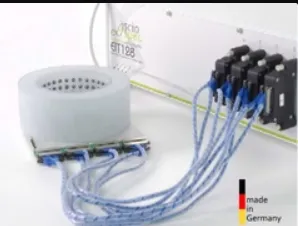
Flexible Fabric Pressure Sensors: EIT-Based Pressure Mapping with Sciospec EIT8
Flexible Pressure Mapping with EIT: Turning Conductive Fabrics into Smart Sensors
The convergence of materials science and precision electronics is opening new frontiers for sensor development. A notable study proposes amathematical model for a flexible, conductive fabric–based pressure sensorthat usesElectrical Impedance Tomography (EIT)to map pressure distributions. This work is an important step toward more advanced and responsive wearables and tactile interfaces.
A Fabric That “Feels” Pressure
At the heart of this sensor concept is a composite fabric that changes its effective electrical properties in response to applied pressure. The mathematical model describes a structure that combines an electrically conductive yarn woven in a wavy pattern with a highly porous, non-conductive textile substrate.
When pressure is applied, the fabric is compressed, which alters its conductivity and, consequently, its impedance. A simplified EIT scheme is then used toimage the pressure distributionassociated with these conductivity perturbations across the fabric.
The implications of this research span several application areas:
Tactile interfaces:Surfaces that can “feel” and map touch and pressure with high spatial resolution.
Medical monitoring:Smart garments or bandages that track pressure in real time to help prevent pressure ulcers or monitor healing.
Material modeling:Experimental validation of complex theoretical models for composite materials using precise impedance data.
Sciospec EIT8: Proving the Concept
To validate the feasibility of the proposed sensor, the researchers used theSciospec EIT8system. This high-precision impedance measurement platform was essential for experimentally evaluating the behavior of the conductive fabric under varying pressure levels.
The stable and repeatable measurements provided by the EIT8 allowed the team to:
Quantify conductivity changes:Accurately measure how the fabric’s effective electrical properties vary as pressure is applied.
Validate the mathematical model:Demonstrate that the one-directional conductivity model aligns well with experimental impedance measurements.
This successful validation showcases how Sciospec’s impedance technology can help turn everyday materials into intelligent, functional sensors.
Allum Corp: Enabling Sensor and Material Innovation in the U.S.
In the United States,Allum Corpis the exclusive partner of Sciospec Scientific Instruments GmbH, providing the impedance measurement technology that underpins innovations like flexible pressure sensors.
If your work involves developing new materials, wearables, or any application that requires mapping electrical property changes under mechanical stimuli, the Sciospec EIT8 and related impedance systems offer an ideal platform. You can contact Allum Corp to explore how Sciospec technology can help validate, refine, and accelerate your next smart sensor project.
Reference
Sciospec.Mathematical model of conductive fabric-based flexible pressure sensor.

